
Florence County Missed-Date Steps
A missed General Sessions date, a city-court ticket date, and a family hearing do not all go to the same clerk. The first task is to identify the case and court. A bench warrant is a judge’s process to bring a person back before that court; it does not end the underlying case.
Keep any notice, citation, or court order and call the clerk named on it. If the file is unclear, the Florence Public Index can help identify a court agency, but the clerk must confirm the warrant and explain the next step.
How Bench Warrants Work in Florence County
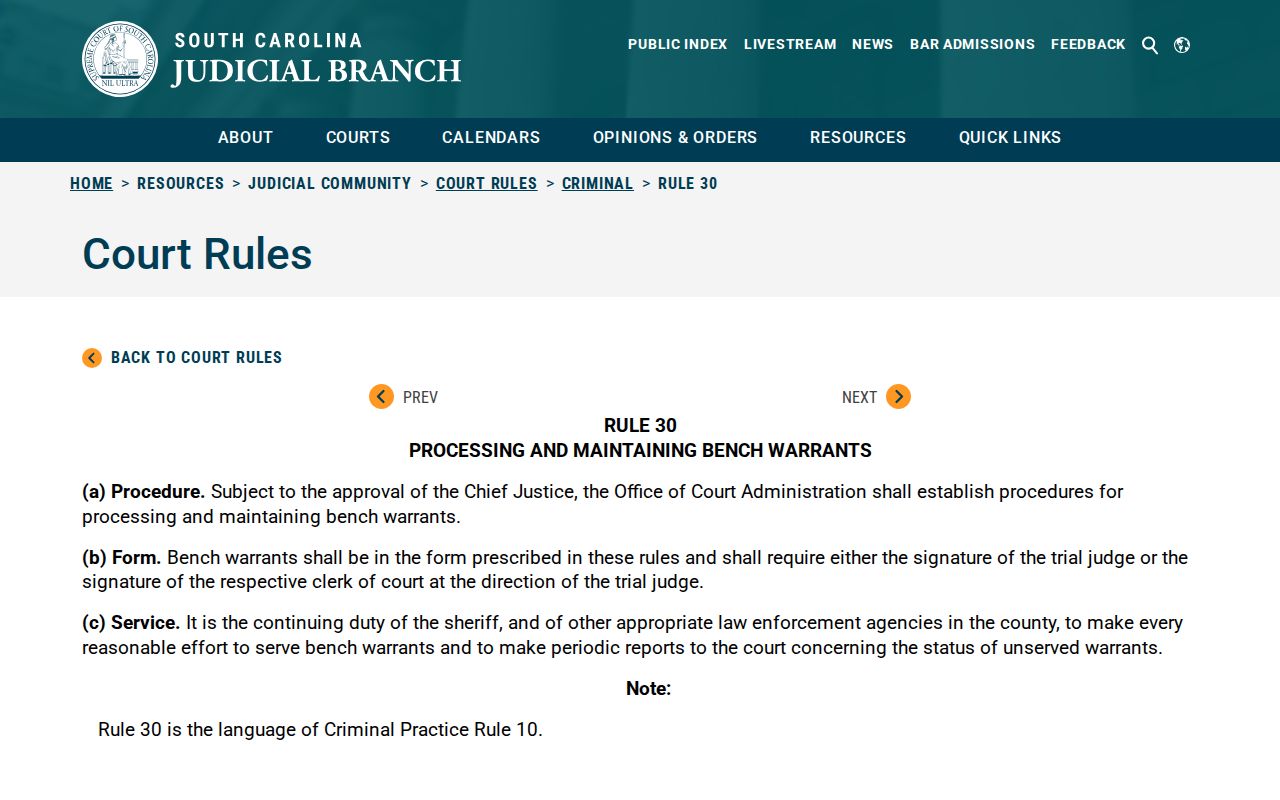
South Carolina Criminal Rule 30 and the court forms describe a process after a judge directs that someone be brought before court. Common triggers in Florence County include failure to appear, failure to obey an order, contempt, or a court-directed condition. A bench warrant can be tied to an existing criminal case, not a new charge.
Family Court follows its own procedure for support and order compliance. A missed date may lead to a warrant, but the court decides what action can recall it. Ask which event is recorded and what date or condition remains.
Florence County’s Two Bench Forms
Blank South Carolina forms show two separate triggers. SCCA523 is titled “Bench Warrant After Failure to Appear.” SCCA522 covers a warrant after trial in absentia, which involves notice and a missed trial. The forms include a case number, date, underlying bond or offense, judge, service certification, and return. They are schema examples only, not records about a person.
Neither form gives Florence County a public warrant-number format. Do not publish protected identifiers printed on the blank templates.
The SCCA523 form shows the failure-to-appear layout.
Use a real case number only when speaking privately with the issuing clerk.
Bench Warrant Issuance in Florence County
A judge determines that a person must return to court, signs the applicable process, and directs service. The court keeps the case and any motion to recall; the sheriff or a city police department may receive the order for service. Florence County has no public statewide warrant database located, so a court record and a sheriff card may not update together.
Rule 30 addresses the criminal form and service reporting. It does not create one countywide online recall form or set a standard grace period before a bench warrant issues. Ask the clerk whether notice was sent and what procedure the judge now requires.
Family Court Bench Warrant Process
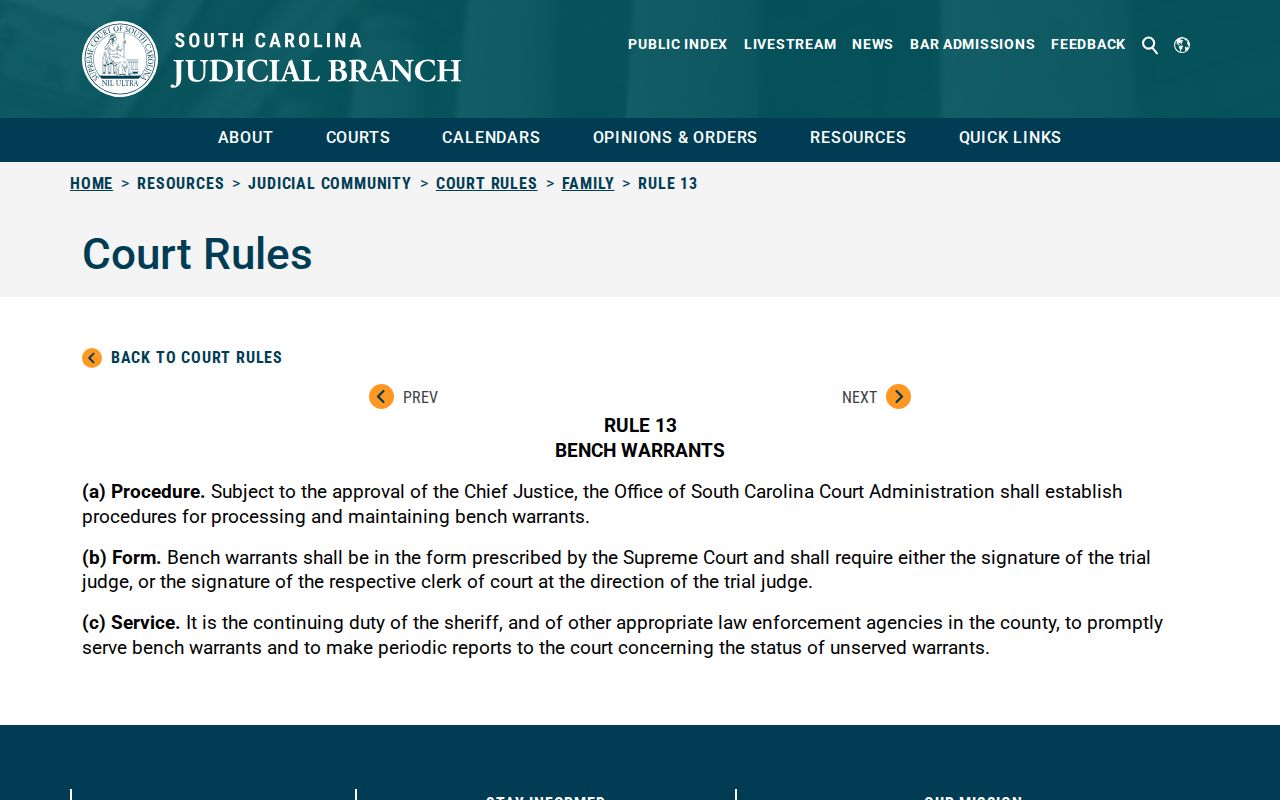
Support, contempt, and other family-order matters belong with Family Court, not a city traffic clerk. Family Rule 13 governs family bench-warrant processing. The SCCA412 family arrest-warrant form is a different instrument and can include an order, overdue amount, clerk affidavit, service, and release terms.
Call the Family Court clerk with the docket number and ask what compliance, purge, or appearance terms apply. A payment or sheriff roster search alone cannot change a family judge’s order.
The Family Rule 13 page explains the court rule.
Confirm the family-court step with the clerk before arranging an appearance.
How Bench and Arrest Warrants Differ
Both can lead to service by law enforcement, but they start for different reasons. A Florence County bench warrant returns a person to court after a missed appearance or order issue. An arrest warrant follows a sworn complaint and a judge’s probable-cause review. The official South Carolina forms and local court routing show why the two should not be treated as the same paper. The arrest warrant process has its own probable-cause path.
| Feature | Bench Warrant | Arrest Warrant |
|---|---|---|
| Trigger | Missed date, order, contempt, or condition | Sworn complaint and probable-cause finding |
| Issuing authority | Judge overseeing the pending case | Authorized judge or magistrate |
| Underlying matter | Existing case or court obligation | Complaint alleging an offense |
| Next step | Ask about recall, reset, or appearance | Ask about service, bond, or counsel |
Capias Terms in Florence County
Lower courts may use “bench warrant,” “failure to appear,” “capias,” or “capias pro fine.” In Florence County, capias pro fine is the useful term for a process tied to an unpaid fine or unsatisfied lower-court judgment. The clerk should identify the exact label, amount, and remedy in the case.
- Recall
- The issuing court withdraws the warrant.
- Quash
- A judge sets the process aside; ask whether a new date remains.
- Capias pro fine
- A lower-court process connected to an unpaid fine or judgment.
Paying a fine does not always close the case or lift every related obligation.
Clearing a Bench Warrant in Florence County
Start with the issuing clerk. Ask whether the warrant is active, what triggered it, whether bond or a purge amount is set, and whether the judge requires a motion, walk-through, or scheduled appearance. A sheriff call can route a service question, but only the court controls recall. No countywide online recall button or universal walk-in schedule was found.
- Use the Public Index or case papers to identify the court and docket.
- Call the clerk and ask which event created the warrant and what the judge requires.
- Ask counsel whether a motion to recall, a walk-through, or a new appearance date is available.
- Keep the order or receipt, then confirm the next case date with the clerk.
Caution: Florence County sources do not establish an automatic expiration rule; confirm status and appearance instructions with the issuing court.
Florence County Bench Warrant Court Map
Bench-warrant calls can go to the Twelfth Circuit Clerk, Family Court, a magistrate, or a municipal clerk. Bond Court at 120 Courthouse Square handles post-arrest bond appearances, not every recall request. Florence County’s seven listed magistrate sites make the court name on the ticket or docket important.
| Case type | First court contact | Published phone |
|---|---|---|
| General Sessions | Clerk of Court, 181 N. Irby Street | 843-665-3031 |
| County traffic or misdemeanor | Florence Magistrate, Courthouse Square | 843-665-0031 |
| City ordinance or ticket | Municipal court that issued it | Use the city court directory |
| Post-arrest bond | Bond Court, 120 Courthouse Square | 843-661-7800 |
The state courthouse directory lists lower-court offices. Call to verify before traveling.
Florence County Courts That Issue Bench Warrants
The Twelfth Judicial Circuit handles General Sessions and Family Court matters; magistrates handle assigned lower-court criminal, traffic, ordinance, and bond work; municipal judges handle city cases. The Clerk of Court, Doris Poulos O’Hara, is listed at 181 N. Irby Street, phone 843-665-3031. Each lower court keeps its own docket and process.
Use the court shown on the citation or docket. If you are not sure, identify the agency in the Public Index and ask that clerk to route the question. The Sheriff’s Office may serve the order, but it does not replace the judge for recall.